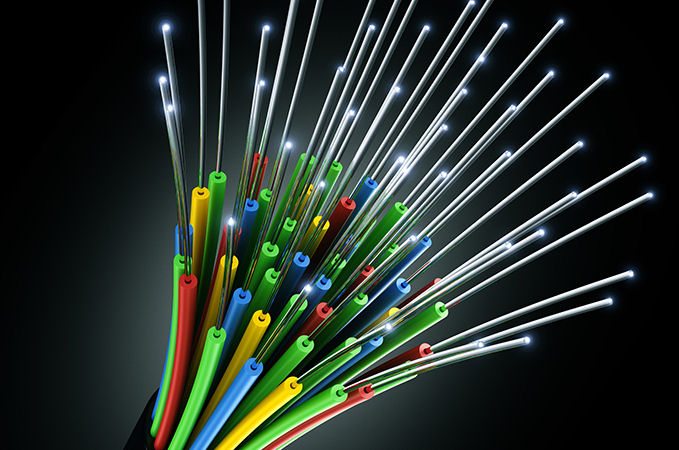
Before we start with our topic, Single Mode vs Multimode Fiber, let’s have a look at what FO cables are. Fiber Optic Cable make up the backbone of nearly all Municipal and Metropolitan communication. It utilizes one or many glass strands to transmit beams of light across a long distance – enabling us to come as close to the speed of light as possible.
This light doesn’t travel through glass as quickly as it would in a vacuum – but it still travels very quickly, which is why it has become so invaluable and widespread in the Layer 1 infrastructure that makes up the Internet.
In our Single Mode vs Multimode Fiber text we will have a closer look at the differences between these two types of fiber optics and the advantages and disadvantages.
What is a Single mode Fiber Optic cable?
A Singlemode Fiber Cable, or Mono-Mode cable, is a type of Fiber Optic communication. It consists of a 9-micron diameter core of glass strands, allowing for only one mode of light.
This makes for a low latency, high throughput cable with very little signal attenuation thanks to a lack of competing modes of light.
This small core allows for theoretically limitless bandwidth, limited only by the power of the receiver and transmitter on each end.
What is Single Mode used for?
Single Mode is used to send signals at great distances – up to 100km until the signal needs to be re-amplified.
This makes it ideal in WAN applications that require a signal to go further distances with higher payloads than other mediums can manage.
What is a Multimode Fiber Optic cable?
A Multimode Fiber Optic cable is the counterpart to Single Mode in Fiber Optic cables. The core of a Multimode cable is much larger, allowing multiple modes of light to travel through the cable at once.
This means that signals must travel a shorter distance due to interference from multiple modes of light competing with one another.
What is multi mode fiber used for?
Multi Mode Fiber is used in situations that don’t require the far reach and care for attenuation that Single-Mode excels at.
Therefore, it sees the most use in LAN environments where large amounts of bandwidth need to be moved many short distances – such as in NAS or Database applications.
Single mode vs Multimode fiber optic: The Differences
Single Mode Fiber cables typically use a core that is a mere 9 µm in diameter – smaller than a human hair.
Because only a single mode of light is transmitting down this core, signal attenuation is minimal and larger amounts of data can travel further without the worry of signal loss.
Multi Mode Fiber hosts a larger core – typically 50 µm for newer cables and 62.5 µm for older Multi Mode formats.
Multiple modes of light transmit down this type of core – and so there is a great deal more traffic inside these cables. As such, it suffers more attenuation.
Single mode vs Multimode: How do I know which Fiber Optic cable I have?
The TIA-598C Standard set by the Telecommunications Industry Association provides us with a precedent for color-coding fiber optic cables.
Traditionally, Single Mode cables are Yellow, while Multi Mode Cables can be Orange or Aqua. Cables can also be identified by model numbers on the jacket of the cable.
Can you mix multimode and singlemode fiber?
No. As in any other cable type, mixing two different formats directly will not work – the cables can communicate with each other using a network switch, but may not be spliced together.